There is a once-in-a-generation event happening right now.
It’s not about the mechanics of the models, the chips, or the benchmarks. It’s about people adapting (or not), reshaping how work gets done, and redefining what “high performance” looks like.
I was in Fort Lauderdale for ITEXPO to speak about building infrastructure for AI with governance in mind. The hype is real, but so is the shift: AI is a tool that will change how we engage in labor across every vertical. It’s an amplifier – amplifying the best of us, and our worst impulses. It empowers thoughtful people to move faster and produce better work. Or it enables an endless supply of garbage output at scale.
What stood out at the conference was the gap between groups of people. Among the partners and specialists, the highest performers are already integrating AI into their business models and how they operate. The ones being left behind are doing exactly what they’ve been doing for the last 15+ years and are unwilling to think that things are changing.
One moment captured the contrast perfectly: we were discussing AI governance and infrastructure modernization, and someone tried to sell me an old phone system. Not “heritage” or “backward compatible.” Just old. And I looked on, amazed at what was happening.

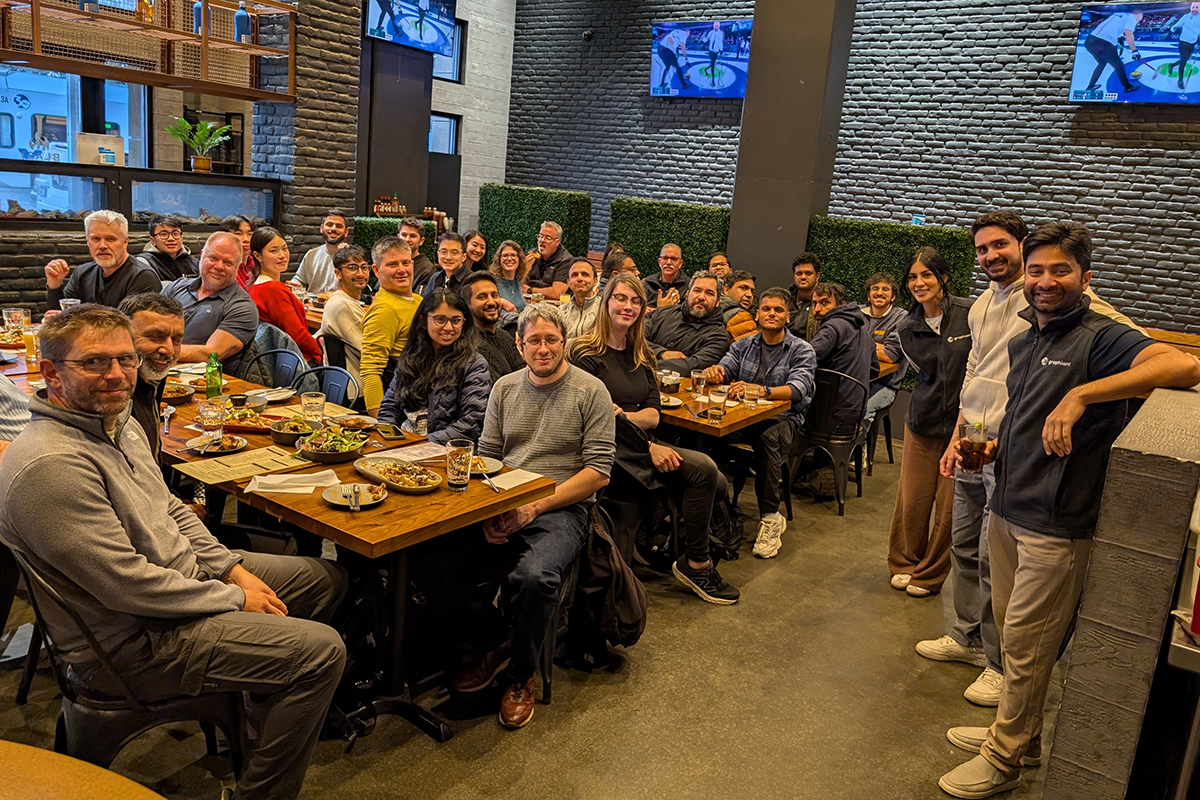
From there, I headed to San Jose to spend time with the Graphiant team. We worked through our AI strategy in detail—what hasn’t worked, what has, and what we’re learning fast.
The most energizing part was seeing the uniqueness of how each person at Graphiant is treating it like a personal engineering instrument or as we call it “their personal intern”. How we’re measuring the efficacy of AI coding tools, understanding what they do well (and what they don’t), identifying which projects are seeing meaningful acceleration, and turning that acceleration into market advantage.
Graphiant is an infrastructure with a mechanism to deliver context directly within the Internet. The implication is simple: when the infrastructure itself can carry context, you can build systems that are more adaptive, more secure, and easier to operate at scale. And once you start thinking that way, you ask: how many functions we’ve historically accepted as “SaaS” should actually live closer to the network?
I kept hearing a line that made me laugh every time because it was both a joke and a thesis: “Infrastructure is back. We are so back.”
I left inspired by the reality of what is possible when a new generation of builders gets a powerful toolset and a contextual foundation to build on.
If markets are uneasy right now, my view is that they aren’t uneasy enough. The change will come fast and hard because the people driving it are passionate, and they’re maturing quickly in how they use AI. Many of them aren’t “just” engineers or “just” developers anymore. They can sell, market, develop strategy, and execute at speed as a single, highly leveraged unit.
I am incredibly proud of the team we have at Graphiant.
It’s more apparent than ever that we’re living in two worlds.
In one, AI is still alien: people can recite the talking points and the buzzwords, but they don’t know how to use it in a way that changes outcomes.
In the other, people are tuning their workflows, sharpening their judgment, and compounding gains. They’re deciding where to apply it, how to achieve the best outcomes and what they can now do that previously required a team, a budget, or a timeline they didn’t have.
That divide is the story. And it’s widening
.png)
.png)
.png)