Graphiant vs Fortinet: The Cost Model Shift from “Features and Bundles” to Network-as-a-Utility
.png)
The AI era is about delivering outcomes. You do not pay for boxes, bundles, features, or license tiers. You pay for the usage of a utility. The network is a data pipeline utility, and how much capacity you need on it is what you should pay for.
The question in this AI era is: How much does it cost your organization to reliably move data—across clouds, regions, partners, and new AI-driven workloads—without losing governance, performance, or sleep?
When you look at that number honestly, the economics shift from “what’s the price of a firewall” to “what’s the price of operational complexity.”
Fortinet is excellent at what it does: security built around FortiGate appliances, security subscriptions, and an ecosystem of management and SASE offerings.
But here’s the trap: licensed security isn’t the same thing as low-cost networking. Your cost still gets shaped by all the licenses for features you must deploy, how many “control planes” you must maintain, how you connect clouds, and how difficult it is to scale partner connectivity without creating operational risk.
Graphiant is different. Graphiant is a Network-as-a-Service, where customers receive ALL features without any licensing. They pay for the network speed they want to utilize for moving data across the business. In a world with agents, you don’t have to build VPN tunnels between every point.
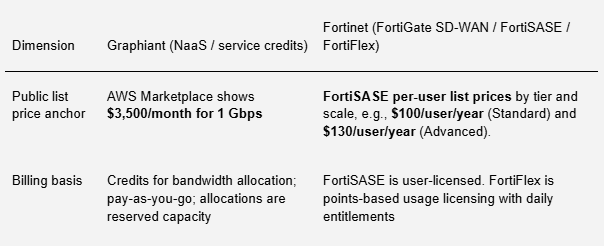
Graphiant has a clear price anchor: $3,500/month for 1 Gbps. Graphiant’s consumption works quite simply: allocations are reserved capacity that you Pay-As-You-Go (charged per Gbps of total speed reserved).
The argument is:
Graphiant makes it easier to treat connectivity as a single service line item with predictable outcomes—whereas Fortinet is a stack of entitlements spanning devices, subscriptions, SASE tiers, and optional consumption programs like FortiFlex.
FAQ: “Fortinet SD-WAN is free and there are no bandwidth charges while Graphiant charges on bandwidth. Fortinet must be cheaper.”
Fortinet’s tunnel options reduces one line item from the overall Bill of Materials, but it doesn’t remove all the individual feature tier licenses for appliances, users, and assembling an overlay (security subscriptions, central orchestration, logging/analytics, operations), nor does it create a governed private middle mile. Graphiant charges on outcome capacity because it sells service outcomes, not features.
FAQ: Graphiant reserved-capacity allocations mean we might overpay when we don’t use bandwidth.
Graphiant ensures pay-as-you-go as a choice. No arrears. No true ups. You pay predictable pricing for the outcome you want.
FAQ: Fortinet also has flexible consumption:
Fortinet is licensing products and services. Graphiant is about an end to licensing individual products and features. Graphiant is about moving to an outcome based model.
FAQ: Partners like the consistency of the previous business model
With Fortinet-based solutions, yes, the incumbency of the past enables business partners to continue to sell the same services they have sold for decades. The challenge that is hidden in the background is that providers and Fortinet are unable to evolve their business model to outcome based frameworks driven by AI.
How a 20-Site Credit Union Cut License and Operations Costs by 50% by Moving from Fortinet to Graphiant
The customer, a 20-site regional institution with 18 branches, headquarters, and a disaster recovery site determined that the economics of keeping a Fortinet-centric WAN running across 20 sites no longer made sense. The environment included FortiGate at the branches, centralized management through FortiManager, centralized visibility through FortiAnalyzer, and recurring FortiGuard subscriptions. It delivered control, but it created a layered cost structure and an operational burden.
For the customer, the problem showed up in ordinary work. Opening a new branch requires planning, licensing, policy cloning, tunnel validation, logging configuration, and failover testing. Renewal cycles were time-consuming. And every budget cycle forced the same question: why did a credit union need a complex bill of materials and networking operations that felt designed for a far larger enterprise.
Graphiant operating model made the transition a compelling business case. Graphiant delivered a policy-driven service that connected all locations at a fixed price. It accommodated growth and movement of sites since the capacity was plentiful for the customer. The service with its end-to-end encryption running on commercial off-the-shelf hardware at $280 per device was incredibly attractive. For a credit union carrying core-banking, ATM, card-processing, voice, and SaaS traffic, that meant the possibility of removing much of the operational burden and deploying better segmentation and control.
The migration journey
The customer was able to migrate in a simple manner.
Annual cost dropped from $300,000 annually under Fortinet to $61,200 after the Graphiant migration, an 80 percent reduction. The savings came from eliminating per-device licensing, centralized management tooling, and branch hardware refresh reserve, while benefiting from extremely cost-effective equipment.
The operational effect was as important as the budget number. New branches no longer started with a licensing procurement exercise. Policy changes moved closer to a service workflow instead of a branch-by-branch device exercise. The infrastructure team spends less time maintaining the WAN and more time working on AI projects, business continuity, and digital initiatives.
“Graphiant gave us leverage,” said customer VP of Infrastructure. “We stopped spending engineering time on branch plumbing and started treating the WAN as a service.”
.png)
.png)